
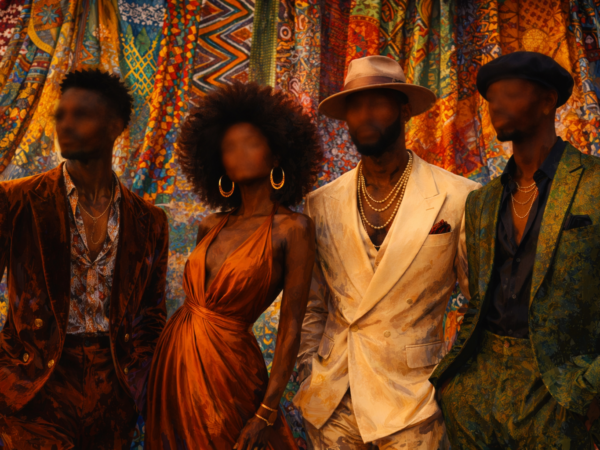
Black dandyism carries history in its seams.
Long before it appeared on red carpets or museum steps, it emerged as a response to dehumanization. Enslaved and colonized Black people took imposed forms of dress and turned them into dignity. Clothing became a language: I am here. I am refined. I am not what you say I am.
That act mattered. It still does.
But when Black dandyism shows up today—most visibly at The Met Gala—it raises a different question. Not whether it is beautiful. Not whether it is valid. But whether it is still moving, or whether it has begun to repeat itself.
Reclamation and creation are not the same thing.
Reclamation reshapes what already exists. Creation originates from somewhere else entirely. It doesn’t need to argue. It doesn’t need to respond. It doesn’t need permission.
At The Met Gala, Black dandyism entered the highest levels of cultural visibility. Tailoring, elegance, mastery. And yet, for many, something felt unresolved. The clothes were impressive—but did they feel alive, or controlled?
This isn’t a rejection of suits, tailoring, or polish. It’s a question about the body.
Clothing is not neutral. Fabric affects posture, breath, and nervous system. Some garments settle the body. Others armor it. What once protected can quietly become constricting—especially when an aesthetic outlives the conditions that produced it.
This same tension appears when we look at hip hop.
Hip hop is often named as an example of Black creation—and rightly so. It originated something new: language, rhythm, posture, worldview. It didn’t ask permission. It spoke from lived experience and reshaped global culture.
And yet, even there, the story is complicated.
As hip hop rose, status was often expressed through European luxury—British-made Kangols, Gucci, Louis Vuitton. These symbols were adapted, flipped, and worn in ways that communicated power and arrival. It was creative. It was expressive. But it was also still relational—using dominant cultural markers to signify success.
That doesn’t make it wrong. It makes it incomplete.
The question underneath both Black dandyism and hip hop style is the same: how far have we actually moved from response into origin?
When expression relies on external symbols of value—luxury brands, elite platforms, institutional validation—it risks staying tethered to the very systems it’s trying to transcend. The look may be ours, but the reference point remains outside.
This is why sensation matters more than symbolism.
Does the expression increase life force, or does it tighten the body?
Does it allow ease, or does it require performance?
Does it originate from lived truth, or from what signals status?
Ancestral cultures dressed for climate, ritual, movement, and meaning. Fabric had relationship—to land, to lineage, to the body wearing it. That relationship has largely been replaced by visibility and consumption.
The issue isn’t whether Black people can wear suits, luxury brands, or high fashion. The issue is whether those forms are still the deepest available expression—or whether they’re simply the most visible. And the question is would we even want to, if it wasn’t for deferring to dominant culture symbols of value.
Creation doesn’t need to be legible to dominant culture to be real.
The next evolution of Black style isn’t about abandoning dandyism or hip hop aesthetics. It’s about asking what comes after reclamation. What comes after adaptation. What comes after proving we belong.
What would Black style look like if it didn’t need to reclaim anything?
If dignity wasn’t something to signal?
If comfort, pleasure, and nervous-system ease mattered as much as impact?
There is no single Black aesthetic. No correct uniform. No final form. The work is internal first—knowing what actually supports the body—and letting expression emerge from that truth.
When style moves from reaction into creation, it stops repeating history. It becomes quieter, clearer, and unmistakably alive.
And that’s when fashion stops signaling status—and starts expressing freedom.
Synthesized by Matt Sherman from group conversations that took place on “The Ality Check” podcast via the erosplatform.com

 Get access to the monthly Rehumanization Magazine featuring contributors from the front lines of this effort—those living on Death Row, residents of the largest women’s prison in the world, renowned ecologists, the food insecure, and veteran correctional officers alike.